
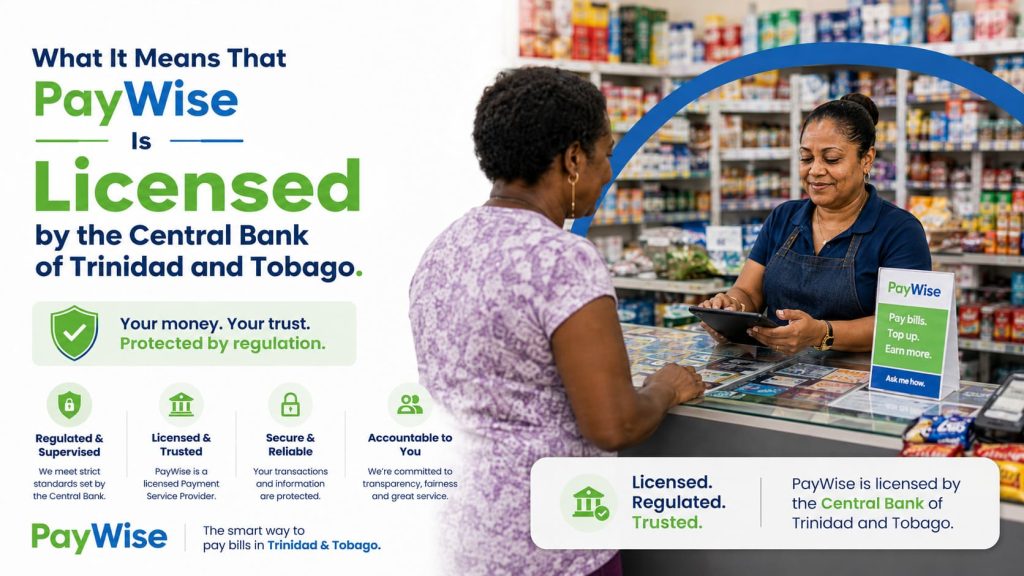
You hear it in every PayWise ad: “Licensed by the Central Bank of Trinidad and Tobago.”
But what does that actually mean for you and your money?
It is not just a trust badge. It is a legal and regulatory framework that protects every transaction you make. Here is a clear breakdown of what the CBTT license means — and why it matters more than any feature on the app.
What the CBTT License Is
PayWise is registered as an Electronic Money Issuer with the Central Bank of Trinidad and Tobago. This is not a casual certification. It means PayWise operates under the same regulatory system that oversees banks in Trinidad.
To hold this license, PayWise must meet specific requirements set by the Central Bank. It is subject to regular oversight. It follows rules about how customer funds are handled. And it is accountable to the same financial authority that regulates every other legitimate financial institution in the country.
In plain language: PayWise is not a random app. It is a regulated financial service, supervised by Trinidad and Tobago’s highest monetary authority.
What That Means for Your Money
Here is what the CBTT license actually does for you as a user:
Your money is protected. Customer wallet balances are held according to regulatory requirements. PayWise cannot use your funds for anything other than what you authorised — your money is your money, separate from the company’s operating budget.
Every transaction is tracked. When you pay a bill, send money, or cash out at an agent, that transaction exists in an auditable system. If something ever needs to be checked — a payment that did not go through, a receipt that got lost — there is a record the regulator can verify.
You have recourse. Because PayWise is regulated, there is a formal channel if something goes wrong. You are not relying on a company’s goodwill. You are protected by a regulatory framework designed to hold financial services accountable to their users.
The license is monitored. The CBTT does not issue licenses and walk away. It monitors regulated entities on an ongoing basis. PayWise must continue to meet the standards required to maintain its license — standards that exist to protect consumers.
Why This Matters in the Trinidad Market
Trinidad has seen too many stories about unregulated platforms freezing funds, disappearing, or failing to resolve disputes. The CBTT license is the difference between a regulated financial service and an app with no accountability.
This is particularly important for a market like T&T, where word travels fast. One bad experience with an unregulated platform can turn an entire community away from digital payments. The CBTT license is your guarantee that PayWise is held to a standard — not just making promises on a website.
When you pay your T&TEC, your Island Finance loan, or your WASA bill on PayWise, the transaction passes through a Central Bank-regulated system. That is the same level of protection you get when you walk into a bank branch. It just happens to take 30 seconds from your phone instead of an hour from your Saturday.
Trust You Can Feel
The features on PayWise — paying bills, sending money, cashing out at an agent — are useful. But they rest on something more important: a foundation of trust backed by regulation.
Every time you open the app and pay a bill, you are using a platform that is accountable to Trinidad’s highest financial authority. That is the confidence that makes the app work. Not because the design is nice. Because your money is safe.
If you have been hesitating to try a digital payment app because you are not sure which ones you can trust, start with the one that is licensed. The CBTT badge is not just marketing. It is your protection.


